

Intrepid traveler, Federica handles the selection and procurement of raw coffee for SpecialCoffee and recently returned from a week of coffee education in Colombia.
This is her travel diary of the Central American country which is one of the most important producers of the best quality coffee in the world.
It is a story made of people, landscapes, aromas, colors, and experiences that I have immersed myself in during these days of travel. It was my first time visiting Colombia.
I experienced all the sensations and emotions of the trip to the plantation.
Obviously, I knew Colombian coffee, while I could not expect how the awareness of the productive realities would change my working and relational life, that it would open my eyes to an underestimated world, made of hard work, amazing people, passion, boundless landscapes, and above all love for the land and for coffee, its main product.
Day 1
I arrive at Bogota airport on time in the early afternoon but my suitcase did not.
After going through the various checks, passing through customs, and trying to figure out how and when I can get my luggage back, Mauricio, the driver who will accompany me and my coffee education colleagues for the entire trip, is waiting for me.
This first day is the time for introductions, handshakes, and the first organizational information on the program of the week ahead.
And then, after a long journey, I go to bed early because the alarm will ring at 4 tomorrow!
Day 2
Wake up early, have breakfast and leave immediately (I don’t even have my suitcase to close) on board a mini-van for a slow and long, up and down, trip through the lively streets of the city of Bogota (at 2,600m above sea level), including the enchanting Candelaria and the confusing streets characteristic of Colombia, colored by fruit stalls and cheered by people dancing and singing.
Here every corner tells a story!
After a 5-hour journey, we reach the wonderful Hacienda Misiones, which extends between 1,600 and 1,800m above sea level, in the region of El Colegio Cundinamarca.
We will experience this unique reality for the next 4 days as we follow all the coffee processing processes, from the nursery to the preparation of the parchment bags destined for the drymill.
Arriving around midday, the ladies of the Hacienda welcome us with a typical Colombian lunch prepared by them: lentil and bean soup, white rice, minced meat and avocado. Nothing is missing to face the work on the plantations!
In these days, thanks to the women of the Hacienda, I will be lucky enough to be able to savor the authentic flavors of real home-made Colombian cuisine.
Even though time passes slowly in Colombia, it is now afternoon and therefore time for an organizational meeting for the days to be spent in the Hacienda.
Sunset is the perfect time to start exploring some corners of this wonderful place where you can breathe an enchanting atmosphere.
Strolling around Hacienda Misiones, I discover how it has been profoundly transformed in the last 10 years by reducing the space dedicated to coffee production to reallocate it to a real farm including agricultural and livestock activities, such as raising beef cows.
I was particularly struck by this somewhat forced choice because it is economically more profitable and less demanding in terms of work and management than just growing coffee.
Day 3 and 4
These are going to be the most exciting days ever!
Waking up in Hacienda, immersed in magical colors and sounds, is something unique.
Breakfast consists of freshly picked mangoes, papayas and pineapples from the Hacienda, scrambled eggs and arepas, all accompanied by a nice cup of Colombian coffee.
And the uncertainty of not always having water and electricity available takes a back seat.
While immersing yourself in the greenery of the plantations, the silence is only broken by the song of the cicadas and the hooves of the horses of the men who supervise the farmers of the finca with their inseparable compañeros mules.
We spend two practical days dedicated to following all the coffee processing processes. However, the agenda is slightly discombobulated because it depends on the weather and here the sun and the rain alternate continuously.
Let’s start at the nursery where there are infinite seedlings growing and destined to be planted cyclically in the plantations.
In reality, the nursery also studies processing systems, plant genetics, climate warnings and disease diagnostics.
In any case, it is a great emotion for me to try to personally plant, with the technique used here, a coffee seedling that 90 days before was just a buried parchment (with an 80% probability of developing).
We then move on to delve into the different botanical varieties of Colombian coffees: Java, Pacamara, Geisha, Bourbon.
But above all, in tasting the different cherries, I discover that already from the fresh fruit you can begin to savor the taste and aromatic differences that will then be expressed in the cup.
Then it is time to pick the cherries that hide the coffee.
But first it is important to know the physical and chemical changes that occur during the ripening of the cherry in order to then distinguish the ripe berries (about 231 days of ripening in the sun) from the immature ones (about 182 days of ripening in the sun) and then collect only the ripe ones.
This step is fundamental because the selection and evaluation of the cherries is based on their level of ripeness. And based on this, as well as the quantity, the pickers are paid.
I realized how important it is to know the drupe (the coffee cherry) in section: pulp, mucilage, parchment (inside which there is the caracolith, which will then become the green coffee bean), pellicle, seed.
But also analyze and evaluate the coffee bean through the Colombian classification (18 premium, 17 supreme, 16 extra, 15 europe e.p., 14 ugq, and below 14 “consumo nacional” which by Colombian law cannot be exported) and the processes used in Hacienda Misiones (natural anaerobic process and washed process).
A long and interesting journey, concluded with cupping and tastings.
Some data particularly struck me because they tell all the work, the people and the passion behind/inside a cup of coffee:
- from 6kg of red berries you get about 1.8kg of parchment (which to become green coffee, will still have to be cleaned);
- a good farmer picks 20kg of berries a day, to earn almost 5 euros a day;
- in an hour I managed to pick 900g of berries.
Absurd!
We conclude the fourth day with a visit to Finca Claudia, in the southern area of the El Colegio Cundinamarca region, an all-female finca with a very small production of about 4,000kg/year of specialty coffee.
And in the meantime my suitcase arrived!
Day 5
The last day at Hacienda Misiones is dedicated to its history, visiting the places where the machinery (no longer used today) tells us how coffee was processed here until about 10 years ago.
They tell us that Hacienda Misiones was founded more than 100 years ago but has always paid great attention to the production processes.
In reality, in this territory, coffee has always grown spontaneously under the natural shade of the trees, at altitudes of 1,600-1,800m above sea level, thanks to the rich volcanic soil.
Hacienda Misiones produces Castillo, Variedad Colombia, Mokka, GEISHA-GESHA, Pacamara, Java, Typica and Bourbon coffees.
For me it was interesting and at the same time curious to discover that, like many mountain agricultural productions (and a bit like what happens with viticulture in Valtellina), coffee in Colombia can also be defined as “heroic” because the work of man is still fundamental.
In fact, after having carefully collected the cherries one by one by hand (picking) and transported them on the back of a mule from the steep mountain hills to the processing station, these coffees are washed with clean mountain water.
Most of the time, the cherries are then carefully de-stemmed before they go into a fermentation plant, where extended fermentations, anaerobic processing and honey can be experimented with before moving to the next step.
Finally, the grains are laid out in the sun to be dried in open tanks.
The drupe waste is used in the compost station to produce fertilizer.
The dried coffee beans are taken to a main warehouse to be transferred to the central mill (drymill) where, deprived of the parchment and selected by size, color and weight, they are mostly packaged in 70kg jute bags.
After these hours of lessons, we enjoy our last lunch at Hacienda Misiones and then head south to Ibagué.
Day 6
Waking up in a hotel in Ibagué is a return to the comforts of the city.
But the smells, sounds, tastes and atmosphere are decidedly less authentic than those of Hacienda Misiones.
This includes the coffee. After days of “espresso abstinence”, I try one in the hotel. It doesn’t resemble my usual espresso (I fear it wasn’t prepared with an Italian blend but with excellent Colombian coffee anyway).
In the end, I must admit that this Colombian experience has taught me to appreciate “long” coffee as a drink to accompany a quiet breakfast.
Then we immediately set off again to visit Finca La Negrita, the farm created by Mauricio Shattah, a very small and highly sought-after specialty coffee finca, which every year produces coffees used on the world stages SCA. It is a very different farm from Hacienda Misiones. Mauricio produces only specialty coffee in the varieties Gesha, Moka, Laurina, Maragojipe, Bourbon, Wush Wush, Pluma Hidalgo, Typica Mejorad.
With him we spend a wonderful day in his plantations which in reality look more like a jungle or a tropical forest. Between various cuppings of his prized coffees we share a typical lunch from the Tolima area based on lechona (pork stuffed with chickpeas and peas) served with arepas while sipping a good Argentinean wine (because I discover that in Colombia they don’t produce much wine).
Day 7
Ready to face the traffic to leave Ibagué and head back north.
After an endless 7-hour journey in a mini-van, we go up to 2,600m above sea level in Bogota and visit Racafé, one of the largest drymills in Montevideo.
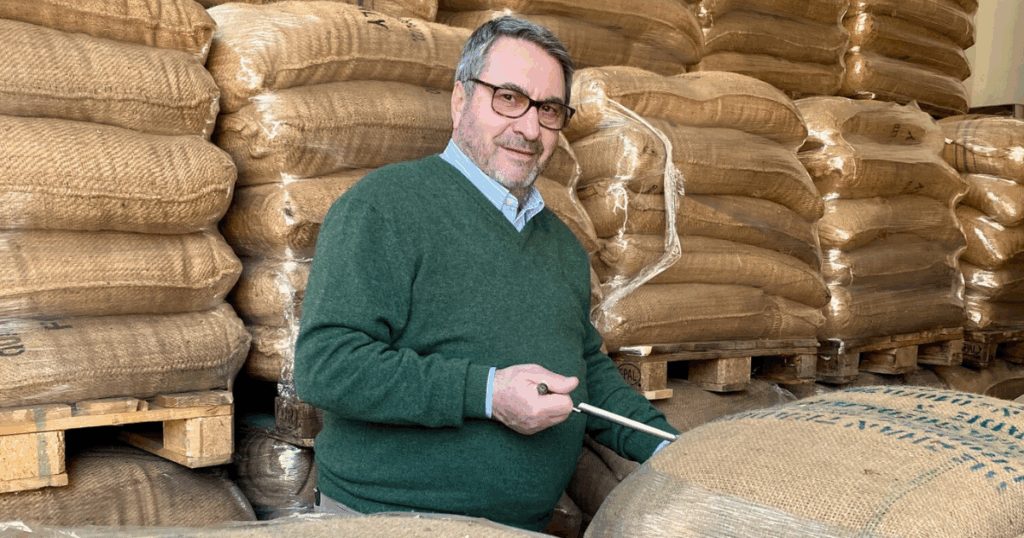
After passing several checks to gain access, we have the opportunity to visit these immense warehouses where real mountains of loose or bagged coffee are stored.
It is here that the various haciendas and fincas in the area (just like Hacienda Misiones does) send their coffee in parchment for the cleaning process and the preparation of the bags that will then be taken to the port to be shipped.
I am thrilled to think that these bags will be the same ones that, as the last step in this long supply chain, we roasters will receive in our warehouses.
Day 8
On the last day of my Colombian experience, a tour of the city of Bogota could not be missed.
We take the opportunity to visit Andrea Onelli, an Italian boy who moved to Colombia more than 10 years ago, in his micro-roastery.
It is getting dark and at 11:58pm I take the flight back to Italy with a great bag of memories, sensations, and experiences.